Monitoring
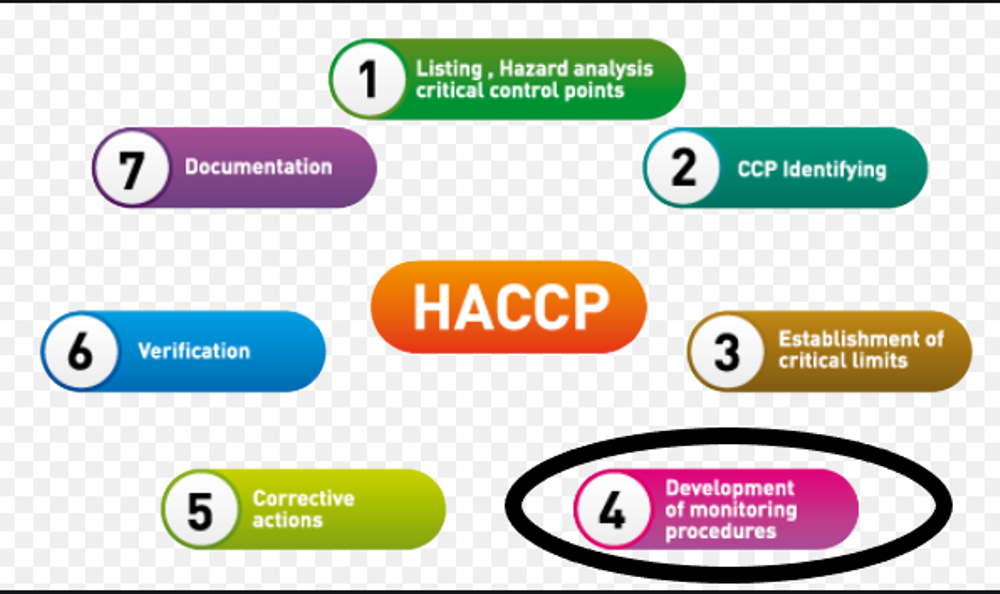
The Codex Hazard Analysis and Critical Control Point (HACCP) system and guidelines for its application defines monitoring as "the act of conducting a planned sequence of observations or measurements of control parameters to assess whether a CCP is under control". Monitoring is the scheduled measurement or observation of a CCP relative to its critical limits. The monitoring procedures must be able to detect loss of control at the CCP. Therefore, it is important to specify fully how, when and by whom monitoring is to be performed.
The purposes of monitoring include the following:
- To measure the performance level of the system's operation at the CCP (trend analysis)
- To determine when the performance level of the system results in a loss of control at the CCP, e.g., when there is deviation from a critical limit.
- To establish records that reflect the performance level of the system's operation at the CCP to comply with the HACCP plan
To establish a system of monitoring, it is necessary to define:
- What is being monitored?
- How it is monitored?
- Frequency. How often it is monitored?
- Who is responsible for monitoring?
Examples:
- What is being monitored? - the temperature of the food (not the temperature of the equipment)
- How it is monitored? - the temperature is checked by thermometer.
- How often it is monitored? (Frequency) - at least every 2 hours.
- Who is responsible for monitoring? - a food operator holding a stated position, trained in the correct monitoring and recording procedure? This person will also have responsibility for initiating a Corrective Action.
Monitoring should provide information in time to allow any adjustments to the process, thus preventing loss of control, delays and interruption to service.