Corrective Action
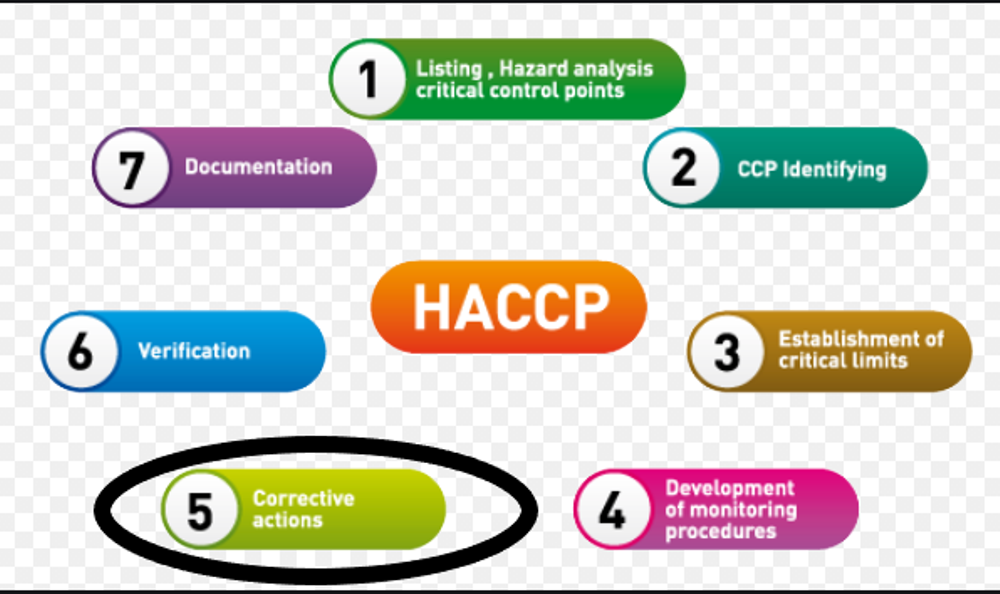
The Codex Hazard Analysis and Critical Control Point (HACCP) system and guidelines for its application defines corrective action as "any action to be taken when the results of monitoring at the CCP indicate a loss of control". Loss of control is considered as a deviation from a critical limit for a CCP. Deviation procedures are a predetermined and documented set of actions to be implemented when a deviation occurs. All deviations must be controlled by taking action(s) to control the non-compliant product and to correct the cause of non-compliance. Product control includes proper identification, control and disposition of the affected product. The control and disposition of the affected product and the corrective action(s) taken must be recorded and filed.
It is important to establish a Corrective Action to be taken when monitoring indicates that a particular CCP is not under control. When monitoring indicates that a CCP is not under control, Corrective Action must be taken. For example, the temperature of cooked meat in refrigerator rises to >10°C for over 24 hours due to a technical fault in the refrigerator. The cooked meat is then destroyed and the refrigerator is repaired by the manufacturer to maintain new cooked meat supplies at the correct temperature at the correct temperature of ≤ 5°C.
The Corrective Action must address the following:
- What is the action to be taken?
- Who is to be informed?
- What to do with the non-conforming product that has been produced?
- Who is responsible for taking appropriate action so that the loss of control at the Critical Control Point will not happen again?
- Who is responsible for ensuring that the appropriate action is taken?
The person responsible for the Corrective Action should be sufficiently informed of the food safety issues involved.
In addition to dealing with non-conforming products, the food business shall identify and eliminate the cause of the issue to ensure the problem does not occur again, for example, repair or replacement of the equipment. All actions taken must be documented.